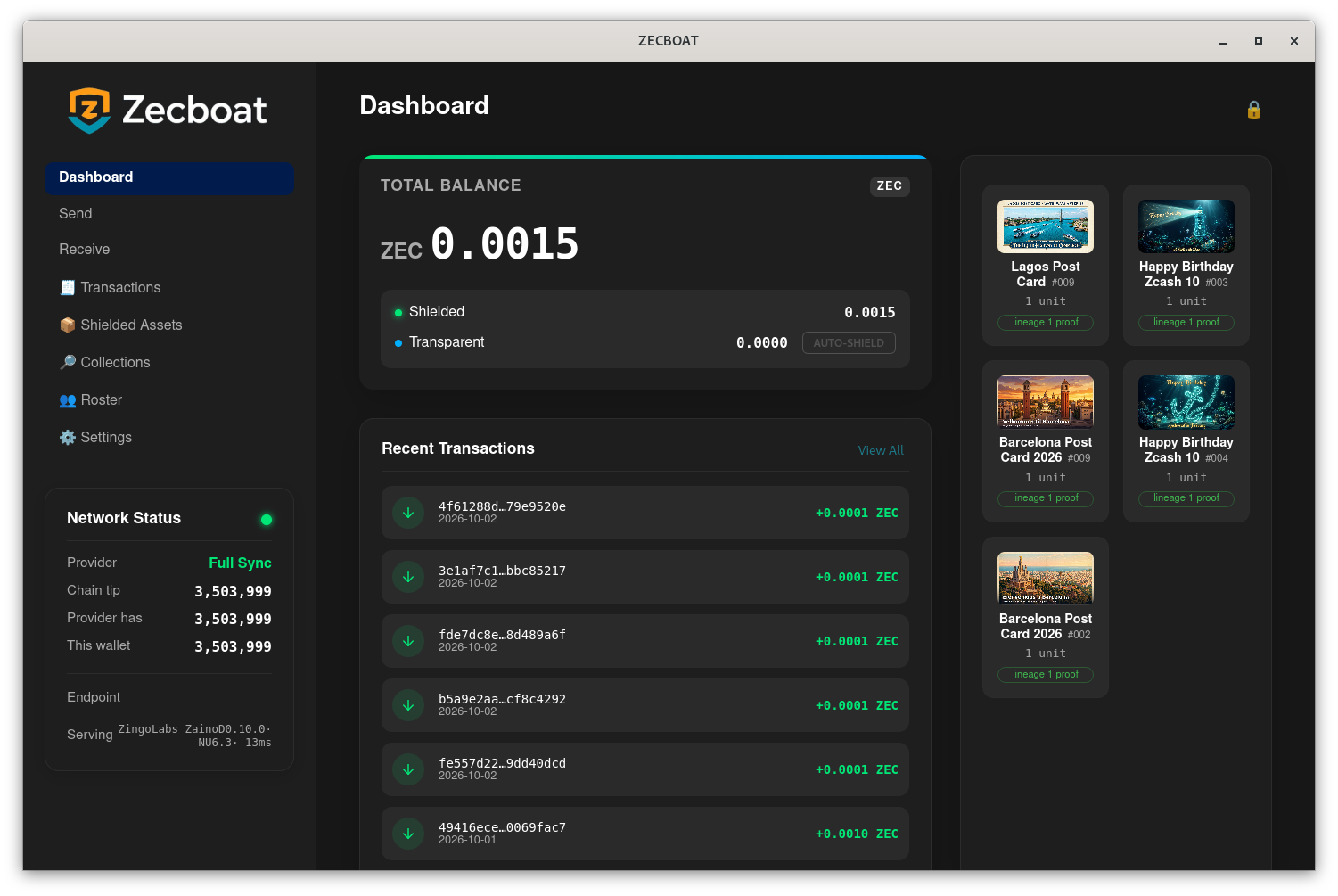
Zecboat Desktop Wallet
Zecboat runs on your machine. Spending keys are encrypted on your disk, transactions are proved locally, and nothing is signed anywhere you cannot see.
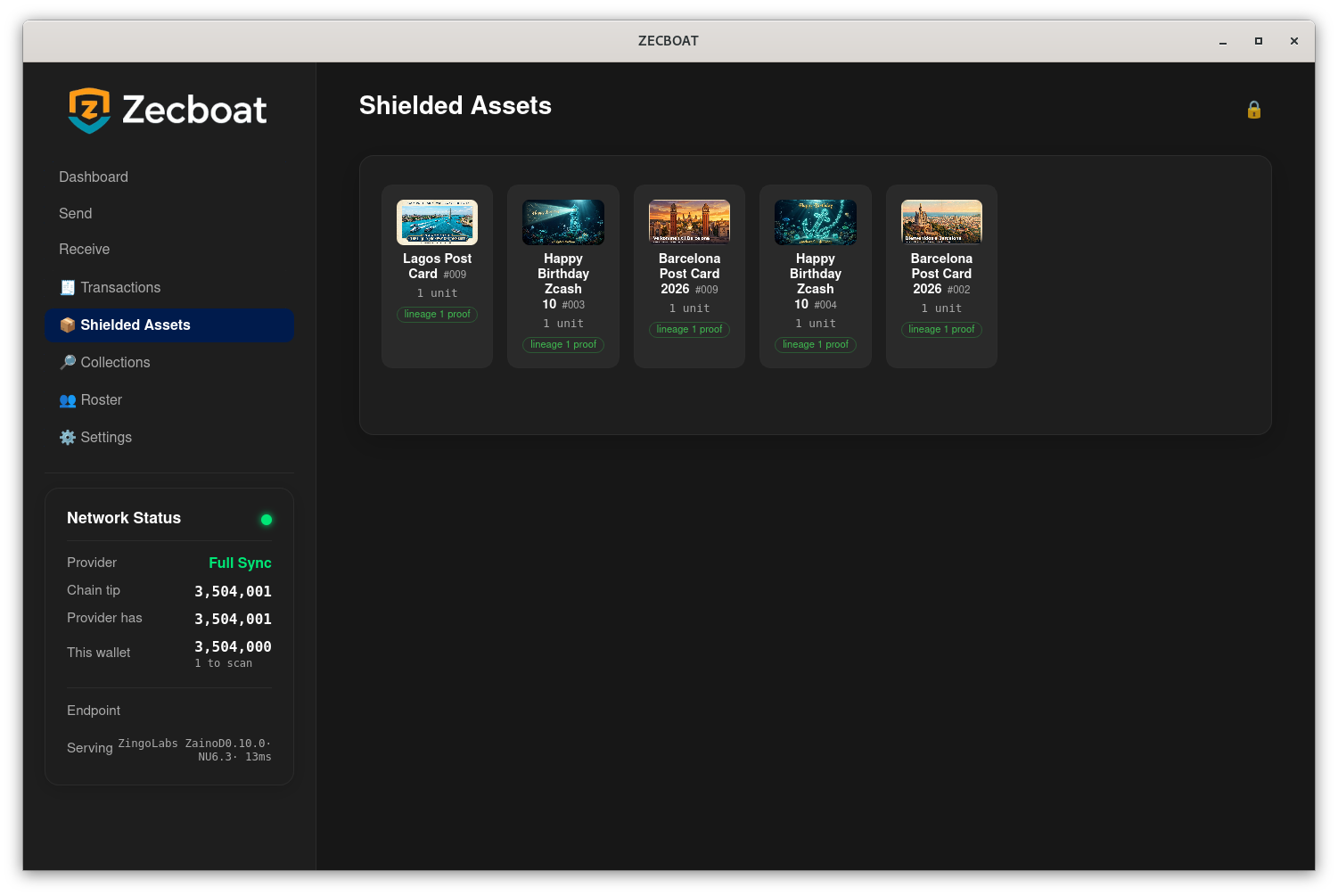
The Network Status panel says plainly where the chain is and how far this wallet has scanned — because a balance you cannot trust is worse than no balance at all.
Every collection, found on the chain
Open Collections and the wallet reads the Zecboat Registry straight from the Zcash chain, through your node or your provider. Nothing comes from zecboat.com.
- Every registered collection, listed
- Search by name, key or asset id; “Mine” shows what you hold
- ✦ N yours: the postcards you hold
✓ genuine✗ failed? not checked yet
How Collections works →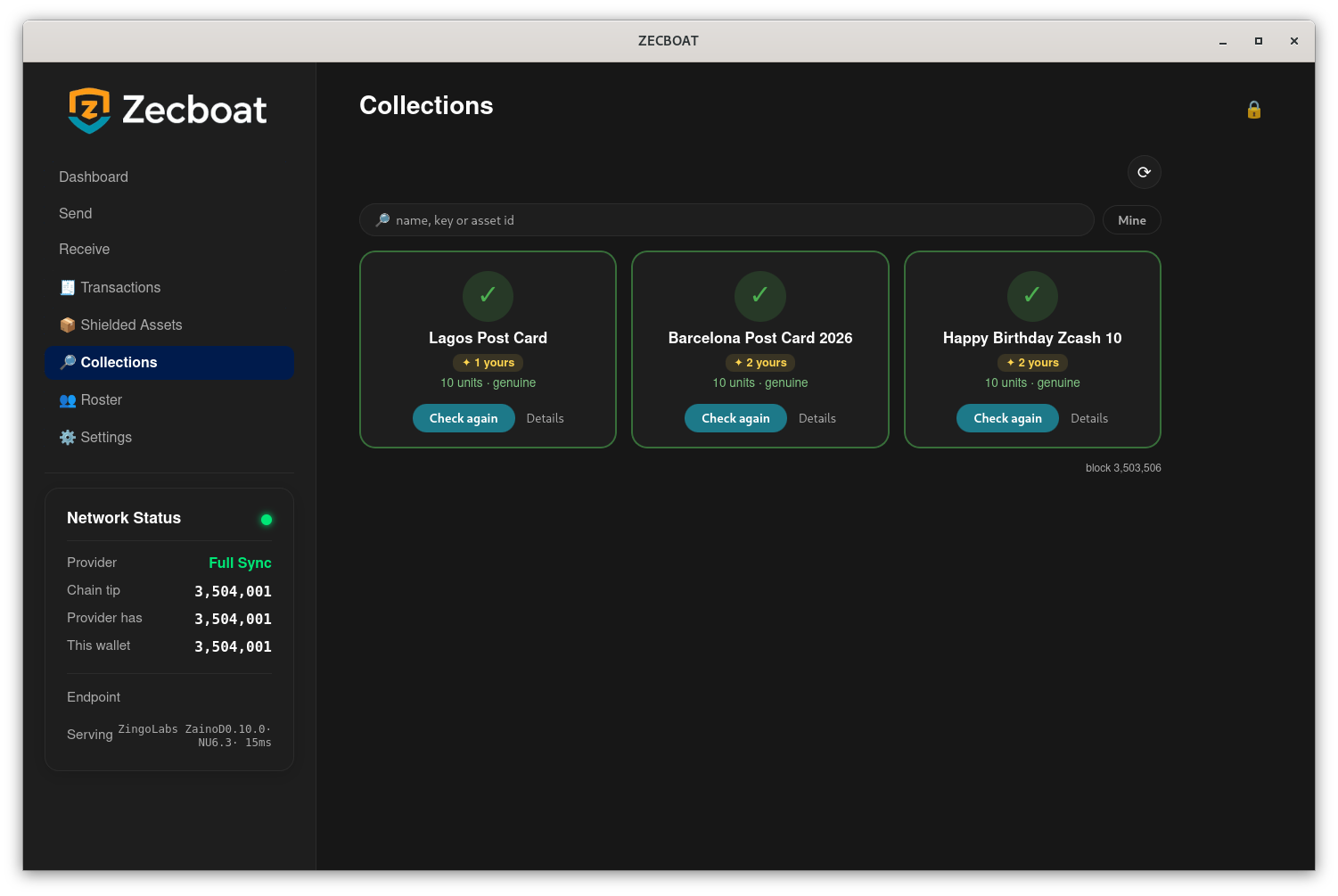
It checks, so you don’t have to trust us
Press Check and the wallet audits the collection from its published viewing key, against the chain: 17 checks. It works even if zecboat.com is down.
- Supply closed on chain
- Every postcard’s id bound to the collection key
- Every zatoshi the issuer spent, accounted for
✓ Verified — issued by … via Zecboat Registry
About the Registry →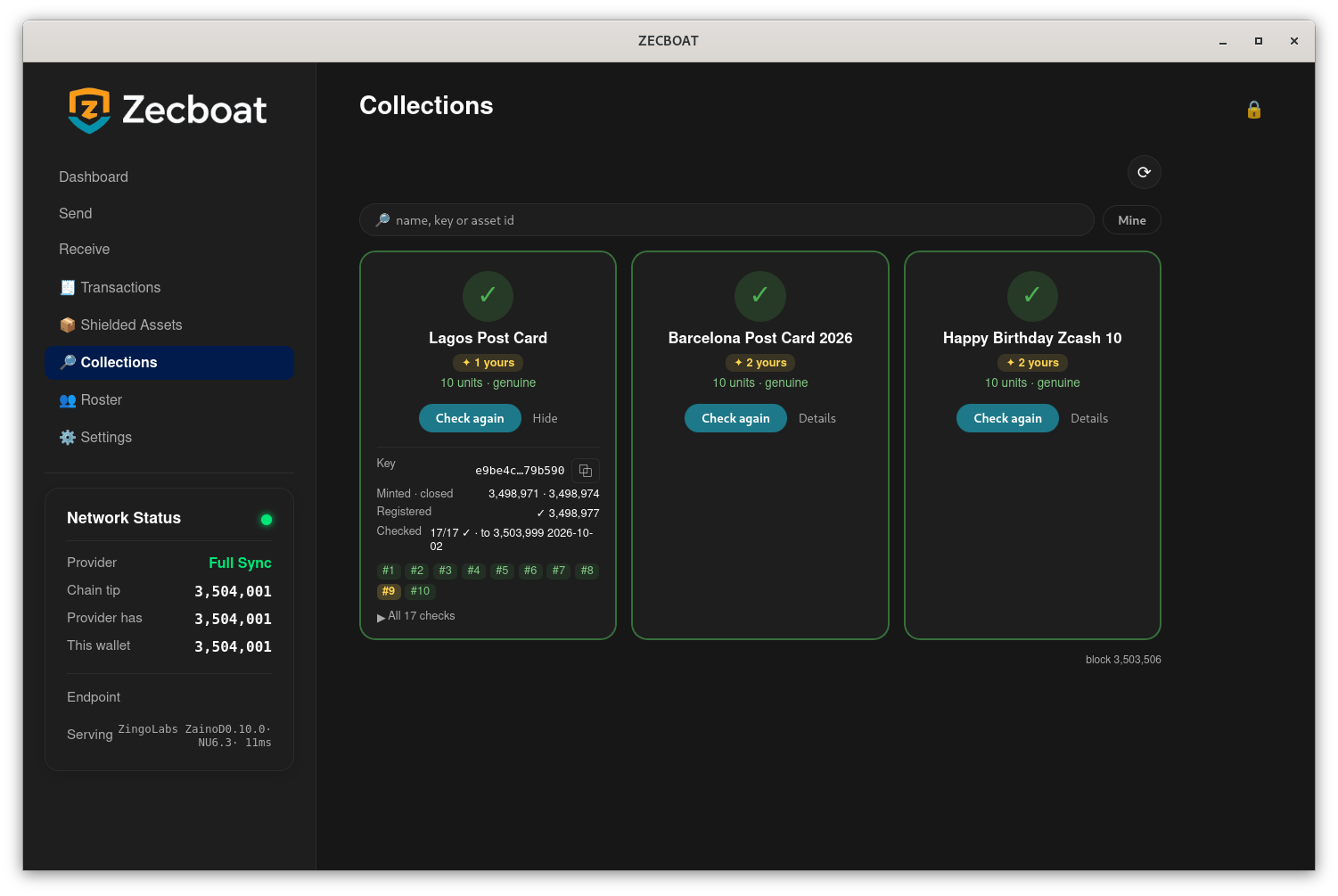
Every postcard carries its trail
Anyone can copy a memo. Wake, our own zero-knowledge circuit, traces a postcard back to its mint without revealing who held it. Not yet externally reviewed.
- Proved before it is sent
- The proof travels in the same transfer, one knot on the chain
- A copied memo arrives with no trail
Without your own node, the chain’s answers come from your provider, and the wallet says so: “Chain answers from: your provider”, “Lineage checks out · your provider”, never “Verified”.
Lineage: Wake and Knotline →Follow the Wake →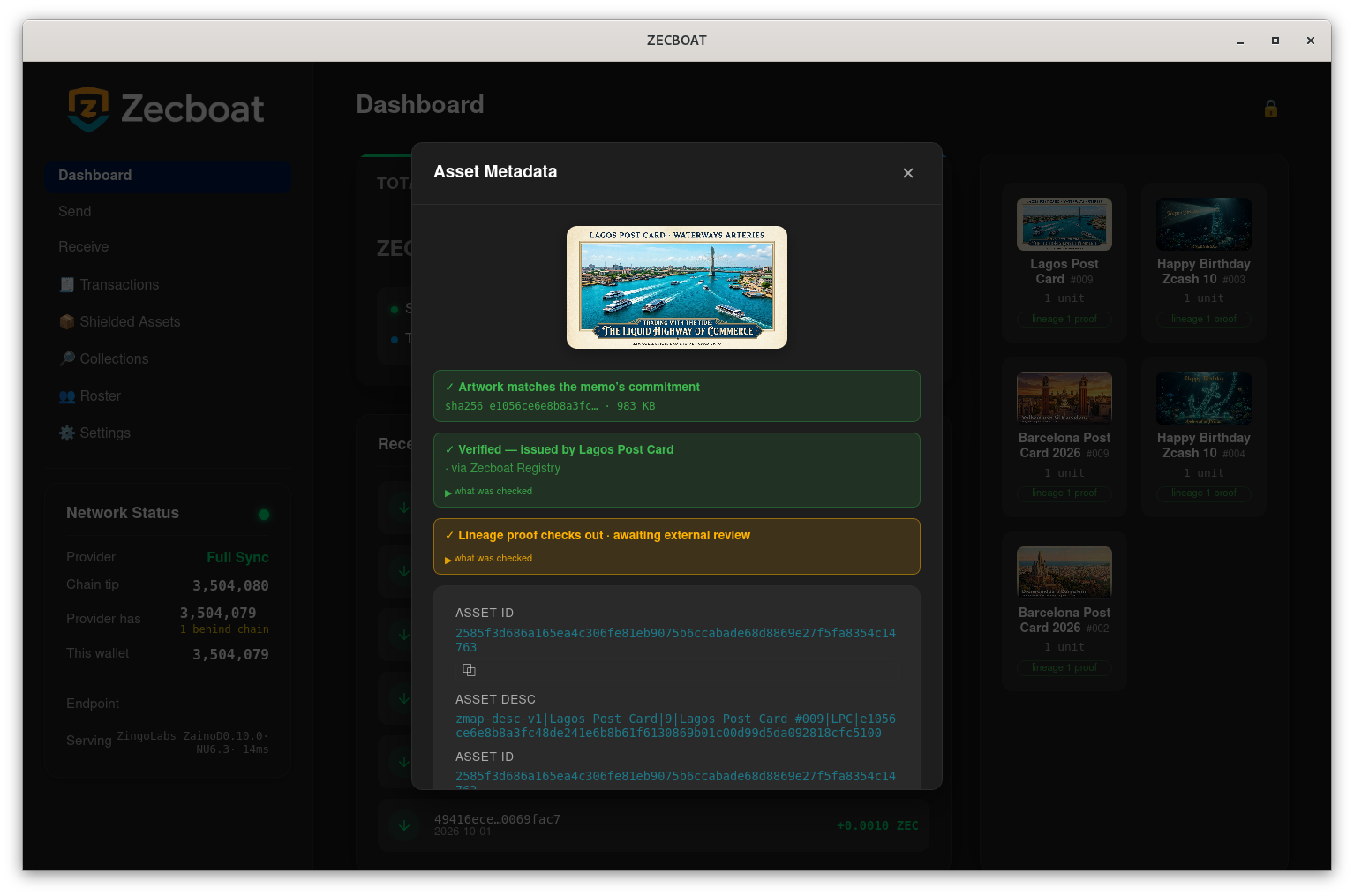
- ◐ Proof checks out trail back to the mint, your own node · awaiting external review
- ◐ your provider same checks, the chain’s answers from your provider
- Unverified not deep enough yet · needs 100 blocks
- No lading the sender didn’t deliver the proof
- ✗ Broken the trail does not lead to the mint
It holds assets, not just value
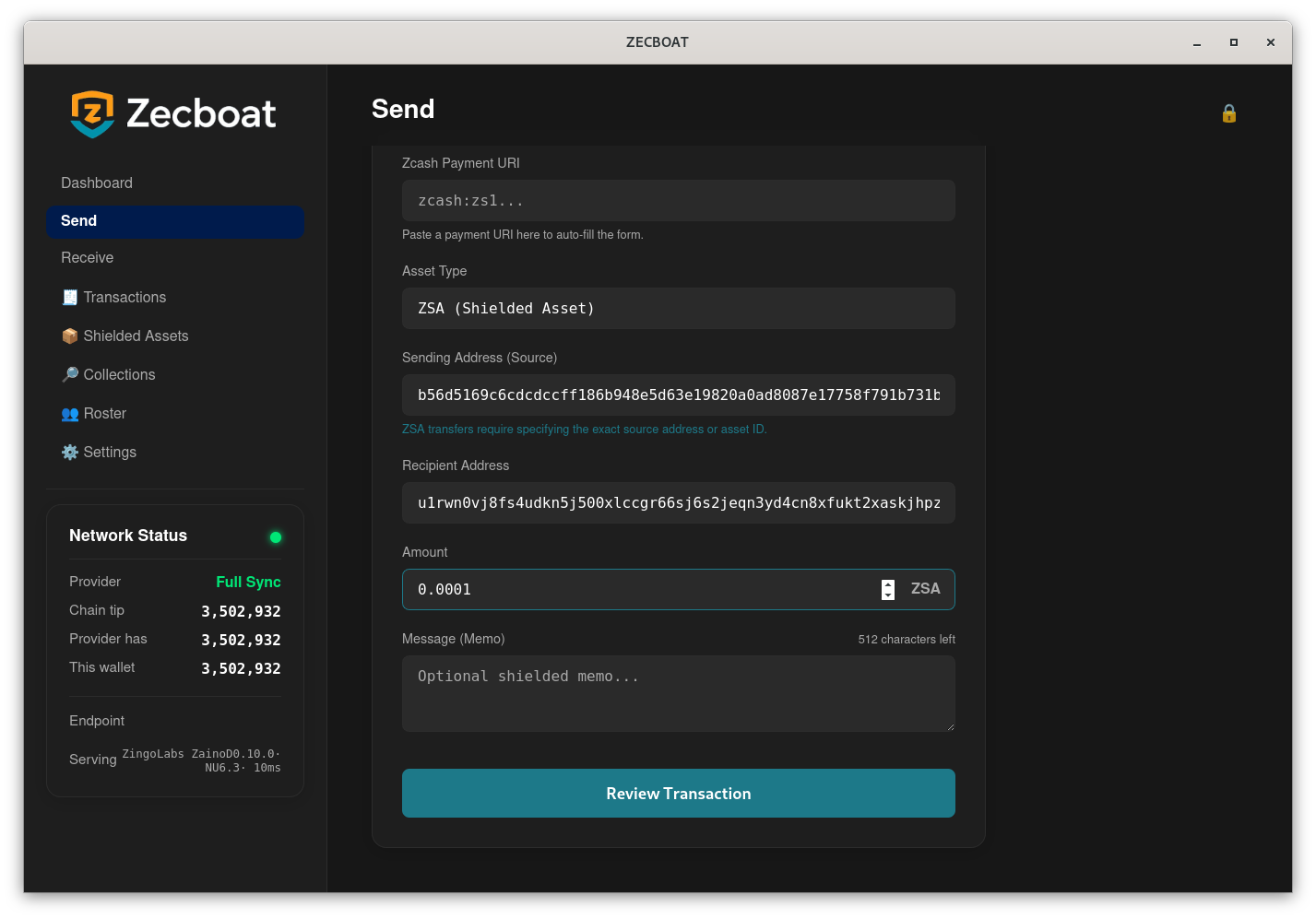
Most Zcash wallets move an amount. Zecboat moves things — a shielded note whose memo is the asset. Sending one spends that exact note and reproduces its memo byte for byte, so custody changes hands while the asset's identity does not.
It is an ordinary shielded note underneath, so it inherits Zcash's privacy with no new cryptography and no protocol change.
- Artwork fetched by its asset id and hash-checked before it is shown
Your assets can't be spent by accident
An asset lives in a small note that an ordinary wallet treats as loose change and, sooner or later, sweeps into a fee. Zecboat locks each one inside note selection, so ordinary sends route around it.
- One postcard per send; the fee comes from your ordinary ZEC
- Balance itemised: spendable · locked · pending · needs a rescan
It cannot create assets — deliberately
There is no mint command, no mint screen and no issuer key handling anywhere in this wallet's code. Issuance is a separate application with separate keys.
That boundary is structural rather than a decision we could quietly reverse, and it is what makes provenance mean anything: a wallet that can mint is a wallet that can forge.

Your keys, your machine
Transactions are proved locally on your own computer. Your spending keys never leave it, and Zecboat never holds your funds — there is no account and nothing to sign up for.
Point it at a public Zcash node, or at your own. Running your own is the only arrangement where nobody else can see which blocks you ask for.
- Restore asks for your node before the seed phrase
- Settings shows the node actually in use
- Setup offers a local node, your own node elsewhere, or a public provider
- YubiKey can protect the wallet’s key file: the setup wizard offers it when age-plugin-yubikey is installed (install_yubikey.sh in the download builds it) · it does not protect spending
Runs on Debian
A .deb and source packages, with hashes signed by our release key that you can check yourself. About a minute. Building from source instead takes 30 to 60 minutes and is how you verify the binary matches the code.